
What a Construction Podcast Taught Us About Leave Coverage
"There is no such thing as a leave of absence here. You're either in or you're out."
A strong performer heard that when he asked for three or four months at home so his wife could take a big opportunity. He took the only option he was given and left. His employer lost someone technically strong who showed up every day, and logged it as a resignation.
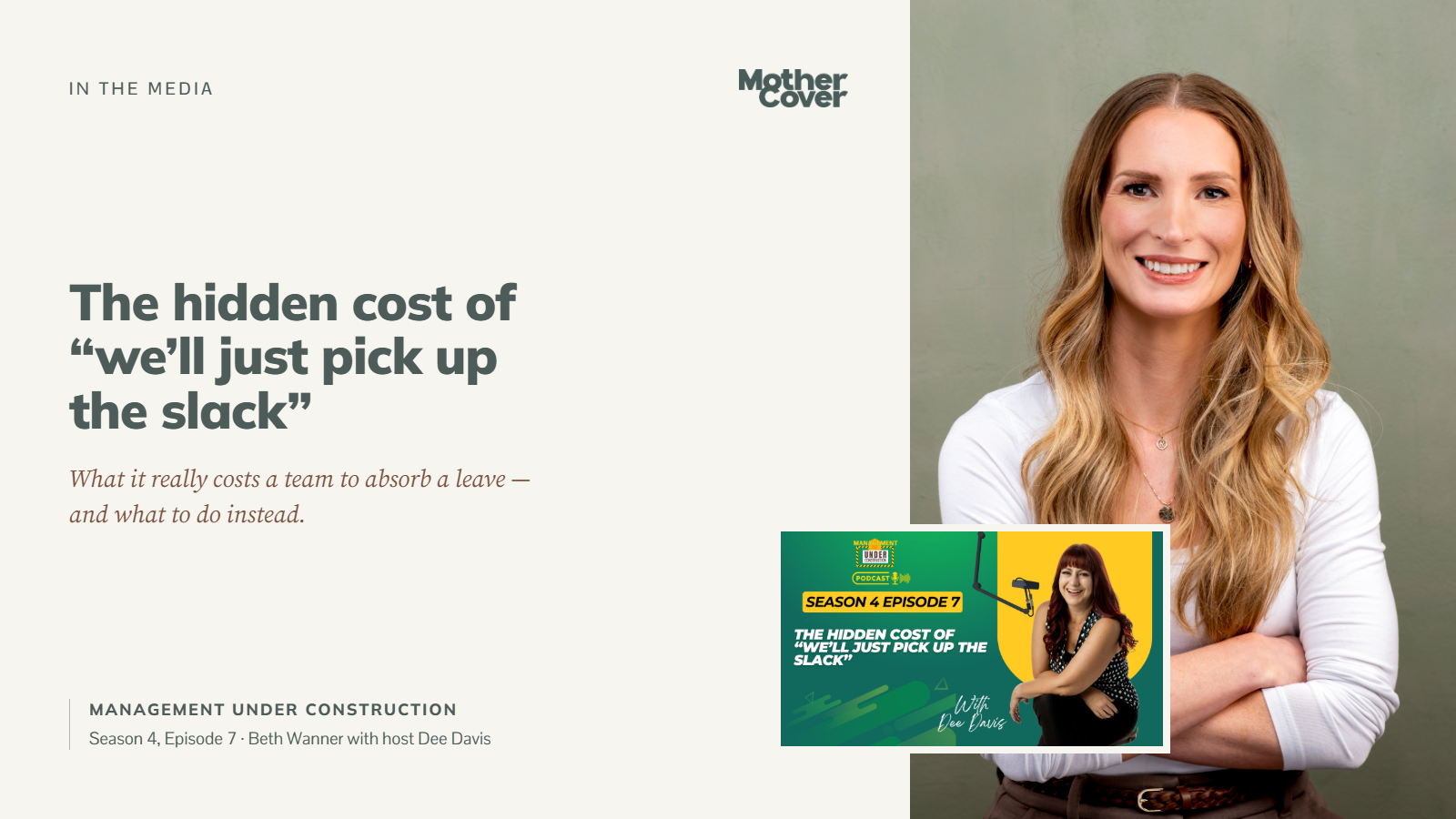
That story came from Dee Davis, host of Management Under Construction, where our founder Beth Wanner joined for a two-part conversation about what actually happens to the work when someone steps away.
The Hidden Cost of “We’ll Just Pick Up the Slack”
Part one covers why Beth started Mother Cover, what happens to a team when a leave goes uncovered, why dispersing the work backfires, and the two data points every company should be tracking about leave.
Employee Leave Coverage with Beth Wanner
Part two covers what a policy actually needs to give managers, the difference between a staffing agency and interim leave coverage, return-to-office pressure on caregivers, what makes a strong interim Leave Partner, and the specific conversations to have before a leave starts.
A different room, the same problem
Mother Cover's clients are mostly tech, consumer brand, and professional services companies. Construction and engineering firms rarely find us, which is exactly why the conversation was worth having.
Dee's listeners tell her that getting away is impossible. Not difficult. Impossible. Project teams don't carry redundancy, the schedule doesn't bend around anyone's personal one, and the job keeps moving whether or not you do. A week of vacation feels expensive. A three-month leave feels unthinkable.
Sit with that for a second, because the same sentence gets said in a Series B SaaS company, a law firm, and a 12-person nonprofit. The industries look nothing alike and the failure is identical. Someone needs time. Nobody planned for it. The work gets spread across a team already running at capacity. Eventually the company loses somebody good, and files it under personal decision rather than structural failure.
Dispersing work is not the free option
The default plan for a 12-week leave is to divide the work among the people who are already there. On a spreadsheet that looks like the option that costs nothing.
Aflac's 2025 Time Away Study measured what it actually costs. Employees covering for a colleague on a leave longer than eight weeks reported moderate to high stress at a rate of roughly 71 percent, and that stress showed up later as turnover on the covering team, and in some cases as their own leave.
The costs stack from there. Replacing an employee runs somewhere between 50 and 200 percent of their salary, before recruiter fees on a senior role. Client-facing and revenue-generating roles carry a bill on top of that. Roughly a third of women leave their roles within 18 months of returning from parental leave, and research from Parentaly found only 3 to 4 percent of them become stay-at-home parents. The rest go to a competitor, usually because they came back to a mess nobody prepared them for.
None of that shows up as a line item. It still gets paid.
The manager lottery
Most parental leave policies are written from a legal standpoint. They answer how much time someone gets and whether it is paid. They do not answer how the role continues while the person is gone, or how that person comes back.
That gap gets filled by whoever happens to be managing at the time. Two employees at the same company, under the same policy, can have completely different experiences depending on who they report to. That is the manager lottery, and it is measurable. Track who takes leave, then track their tenure after they return. If the outcomes swing wildly by manager, the policy is not the thing that is broken.
Five things worth doing before the next leave lands
Count your leaves. The number is more predictable than most companies assume, and once you have a baseline you can forecast it. Setting aside roughly 1 percent of the salary line gives you a contingency pool to draw on.
Run the double circle exercise. Circle every critical role. Circle every person you want to keep. Start your coverage planning with the people who have both circles.
Track tenure after return, not just return rates. Coming back for six weeks is not retention.
Start the coverage conversation three to four months out. Both sides tend to avoid it until the last few weeks, and babies do not respect notice periods.
If you are the one going on leave, ask for a performance review before you go. Managers change. Roles get reshaped. A documented record of where you left off protects you and your employer both.
Where we fit and where we don’t
We can't backfill a laborer or a site superintendent, and we won't pretend otherwise. But every construction and engineering firm is also running on people in finance, HR, marketing, estimating, and project controls. Those roles go uncovered in exactly the same way, and they are the ones we can step into.
Mother Cover places senior interim professionals, our Leave Partners, into roles during parental, caregiving, medical, and mental health leaves. Everyone on our roster has at least 10 years of experience, because a manager covering a temporary leave does not have a month to spend onboarding. We build in overlap with the person going on leave, document the role while they are out, and hand it back at least as well as it was left.
Leave shows up as parental, medical, caregiving, mental health, and sabbaticals, across every industry, every role, and every gender. The only thing that changes company to company is how honestly anyone plans for it.
If you have a leave coming up and no plan for the work, we can help you build one.
At Mother Cover, we help companies build leave programs that actually work—from sourcing interim and fractional backfill talent to guiding leaders through transitions with confidence. Because parental leave doesn’t need to be a career or team setback.
🌱 Temporary leave. Not permanent setbacks.
→ Need support for an upcoming leave? Let’s talk.
