
What Is Parental Leave Coverage? How Interim Talent Protects Business Continuity
Parental leave is a business continuity event. Most companies treat it like a scheduling problem. The ones that get it right treat it like what it actually is: a talent strategy decision.
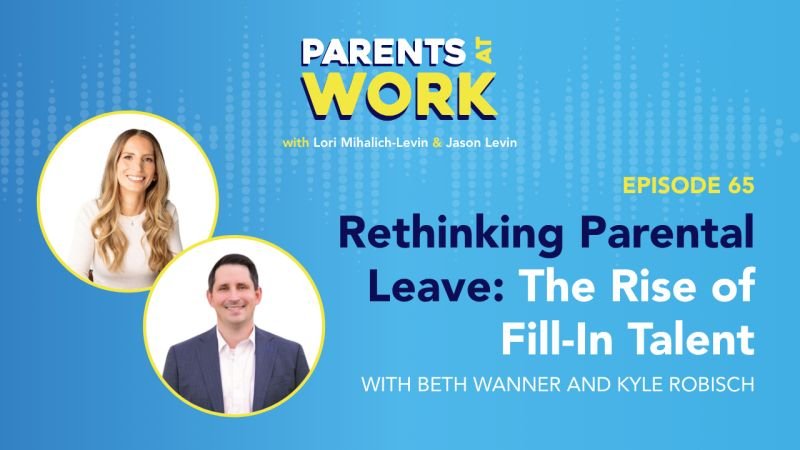
We were recently a guest on the Parents at Work podcast alongside Kyle Robisch, Partner at Latitude, a flexible legal talent company. We got into what parental leave fill-in talent actually is, how it works, and why more companies are making it a standard part of workforce planning.
Here is what that conversation surfaced, and what we see on the ground every day.
What Is Parental Leave Fill-In or Backfill Talent?
Parental leave backfill or fill-in talent refers to experienced interim or fractional professionals brought in specifically to cover a role while an employee is on leave. This is different from a temp hire or a staffing agency placement. The person stepping in understands they are carrying someone else's work forward, intentionally.
At Mother Cover, we describe it as a relay race. The baton gets handed off carefully, carried with intention, and handed back. The person on leave should return to a strategy that kept moving, not a pile of things that stalled while they were gone. That distinction matters more than it sounds.
Coverage can look different depending on the role and the organization. Some companies bring someone in full-time, like-for-like. Others bring in fractional support, covering the highest-priority work without a full-time commitment. In some cases, multiple people cover different parts of one portfolio. The right structure depends on the role, the team, and the work — not a one-size approach.
Kyle put it this way on the podcast: you can tie the coverage to the person and the role, not just the open calendar slot. You can do it flexibly. And sometimes you see people bring in multiple people for one person out, depending on what that person's portfolio was.
What Roles Can Be Covered?
Mother Cover places experienced professionals across marketing, HR, finance, operations, and any function that can be done remotely or in a hybrid environment — from senior individual contributor through C-suite. We step in for parental leave, medical leave, caregiving leave, mental health leave, interim needs, and sabbaticals.
If you have something you care about that requires time away, your organization should have a way to support that. It should not require you to choose between your career and your life.
“Everybody has things that they care about in their lives that requires support. We shouldn’t have to decide whether we’re going to care for ourselves or our loved ones and sacrifice our career.”
Kyle and his team at Latitude focus specifically on legal talent: attorneys, legal operations professionals, and paralegals. As he joked on the podcast, put the two of us together and you'd have a super leave company that could cover almost everything.
The framing we keep coming back to: everyone has things they care about that require time away. It should not be something you have to choose between. Your career or your family. Your health or your job. That is the problem we are both trying to solve, from different angles.
What Is the Business Case for Parental Leave Coverage?
Five or ten years ago, companies needed convincing. Kyle has noticed a shift. On the podcast he said that when companies come to him now, he has to do very little explanation — they are often coming because they have already figured it out themselves, or because they have lived the version of what happens when you get it wrong.
What does getting it wrong look like? Kyle called it out clearly: you risk losing two groups of people, not one.
The team doing the covering burns out.
When a key person goes on leave and the work gets dispersed across the existing team, those people are already at capacity. As Kyle described it on the podcast: they are busier, more stressed, more exhausted. There is resentment, even when nobody wants to feel it. Burnout builds. Retention problems follow.
We would add: teams are leaner than they have ever been. What used to feel manageable when workloads were dispersed is now a real problem. I would argue it was never working well, but it is certainly not working now.
The parent cannot actually step away.
If there is no one to catch the work, the parent is never really off. They are still fielding messages, still worried about what is slipping, still apologizing for leaving. Kyle put it directly: you have a parent who is not allowed to fully check out because the system is not in place, so they end up doing some or all of their job. That is not real leave.
This is something we’ve felt personally. The moment you announce a pregnancy or a leave, so many parents feel like they are delivering bad news. You are sharing something exciting while simultaneously bracing for the reaction. On the podcast we described it as doing it apologetically — I am sorry I am going to step out, I am sorry I am going to put this on my team.
That feeling is not unique. We have talked to parents across the US, Canada, the UK, Europe. It is universal, regardless of the very different policies and laws each country has.
“You can give that parent who’s out peace of mind knowing, hey, I can fully step away and I can be with my baby and my family right now. And then on the flip side, you also signal to your team, hey, we’re not asking you to do two jobs at the price of one.”
The math on not covering leave.
Ernst & Young research estimates the cost of replacing a departing new mother at approximately 150 percent of her annual salary. Maven Clinic research shows that more than 75 percent of expecting mothers plan to return to work — but 43 percent end up leaving anyway, and half of those who do return take lower-paying positions.
The most common reason is not a desire to stay home. It is that they returned to a situation that felt untenable. Or they never fully disconnected in the first place, and they burned out before they even came back.
Maven Clinic data also shows paid leave policies can reduce turnover by up to 69 percent. But here is the thing: a paid leave policy without coverage support is an incomplete sentence. You have told someone they can take time off. You have not actually given them permission to use it.
The upfront cost of interim coverage is visible on a P&L. The downstream cost of not doing it — missed goals, burnout, attrition, parents not returning, re-recruiting — is harder to model but much larger.
How Does Parental Leave Coverage Work? The Transition Process Explained
Coverage is not just about finding someone. It is about building the right structure so everyone succeeds: the person on leave, the team, and the interim professional stepping in.
Before leave begins: the transition period
At Mother Cover, we require at least a two-week overlap between the leave partner and the person going on leave. Longer is better, even if we start out small with something like five hours a week. During that window, we work through transition documentation, context transfer, and stakeholder communication — what is mission-critical and what needs to be handled differently when coverage is fractional rather than full-time.
The manager has to be part of this process, not just the parent. We learned that through experience. We have had engagements where the transition documents were thorough but the manager was not fully looped in on how the work had been parsed. The Leave Partner showed up and the structural misalignment created slight friction that could have been avoided.
Communication to the broader team matters too, especially with fractional coverage. The team needs to know what is different, what the working relationship looks like, and who to go to for what. That is not a one-email job.
Kyle and his team at Latitude have a similar approach — best practices around overlap on both the ramp-in and ramp-out, and no rigid requirements, but a clear set of guidelines they have refined through each engagement.
During leave: keeping the parent informed without pulling them back in
We ask the parent upfront what level of communication they want. Some want a monthly update — a light touch that lets them stay loosely oriented without being pulled into decisions. Others want to fully unplug. We write those updates either way. If the parent does not want them in real time, they get compiled into a return brief.
That return brief matters more than most people realize. Instead of coming back to a thousand unread emails and a blank stare, the returning employee gets the breadcrumbs of context: what decisions were made, how things moved, where things landed. They can re-onboard with continuity rather than starting from scratch.
The return: ramp down and re-entry
Just as the transition in is gradual, the transition back should be too. The Leave Partner ramps down as the returning employee ramps back up. There is a real handoff, not just a date on a calendar where everything is supposed to snap back into place.
Lori of Mindful Return and co-host of Parents at Work made a comparison on the podcast that really stuck out — the ramp-up period for a Leave Partner is like easing a child into daycare. All in on day one is rarely anyone’s preferred move if given the choice. A few hours, then a bit more, then full days. Gradual transitions work because they give everyone time to adjust. Leave coverage is the same.
Should the Employee Going on Leave Be Involved in Selecting Coverage?
Yes. And it changes the whole dynamic when you do.
Kyle shared on the podcast that some of their best engagements start with the person going on leave being the first to interview candidates. That person knows the work best. They know the personalities upstream and downstream. They know what a good fit actually looks like far better than a job description can capture.
“I’ve also seen that it’s usually helpful to have either the first or second person doing the interview of potential candidates be the person whose leave is being covered. It gives that person buy-in — they’re not going to take my job, I’m part of this process, I’m good.”
At Mother Cover it works the same way. Sometimes the parent is the one who finds us and brings us forward to the company. We almost always have them closely involved because they are closest to the work.
There is also a fear worth naming directly that Kyle alluded to: that the interim person is there to outshine them. Or take their job. We address that contractually. Our Leave Partners cannot take the role permanently unless the parent decides they do not want to come back. Their job is to carry the work forward and make the returning employee look good. That is the whole point.
What happens when it goes really well: a real example
Kyle shared a story on the podcast that illustrates what good coverage can unlock. A major energy drink company brought in a senior attorney on a six-month leave coverage engagement. The first interview was done by the attorney going on leave. The general counsel did the second. Both said yes.
Six months became eight — not because the leave extended, but because the interim attorney had become so embedded and valuable that the team needed more time with them. They had also picked up workflows that had not existed before.
Then, a week after the engagement wrapped, Kyle got a call. A permanent position had opened. The attorney whose leave had just ended called and said the interim attorney was literally perfect for the job. Could they hire her?
That outcome was possible because the process was done right at the front end. The returning attorney had buy-in from the start. There was no threat, no competition — just a clean handoff and a new opportunity that benefited everyone.
Kyle put it simply: they come back and the shop is as clean as they left it, and in some ways even better. That is the goal.
What Should You Look for in a Parental Leave Interim Professional?
Skill is table stakes. What separates a good Leave Partner from an average contractor is everything around the skill.
At Mother Cover, everyone on our roster has a minimum of ten years of professional experience. At Latitude Legal, their attorneys and legal professionals come from top law firms and in-house legal departments — people who can parachute in, know the language, and do high-level work from day one.
Beyond experience, both of our companies screen hard for the same things.
Low ego. You may have been a VP or a general counsel in a previous role. In this engagement, you are in service of someone else's strategy and reputation. Kyle described it on the podcast as knowing where you fit into the grand scheme of what you are stepping into. That self-awareness is non-negotiable.
Empathy and emotional intelligence. You are stepping into a role mid-stride, during a sensitive moment for the person leaving. The best Leave Partners understand that the work is personal. They treat it that way.
Mission alignment. Most of our Leave Partners come to us through word of mouth, we never do public job postings. Many are parents themselves who had difficult leave experiences and want to build something better for the people who come after them. That orientation shows up in how they do the work.
The ability to hand back the baton. The most underrated quality. The best Leave Partners are building toward giving the role back in better shape than they found it. Not acquiring. Not empire-building. Serving.
“It’s not about what stars are you adding to your resume anymore. It’s really about doing this in service of somebody else’s strategy, somebody else’s professional reputation. How do you carry that forward? ”
How Do You Know If Your Organization Needs Parental Leave Coverage?
If a key person on your team went on leave tomorrow, what would actually happen?
Would the work get covered? Or would it get dispersed across a team that is already at capacity? Would the parent feel like they could fully step away — or would they stay reachable because there is no one to catch what they are carrying?
Most companies already know the answer. They have watched a senior person go out and seen what it did to the team. They have watched a parent come back to find their role changed, their standing uncertain, their strategy stalled for months.
Kyle said on the podcast that the business case has gotten easier because companies have lived the alternative. We see the same thing. More organizations are coming to us proactively, recognizing that what they did in the past is not going to hold. Teams are too lean. The cost of getting it wrong is too visible.
Parental leave coverage is not a perk. It is a workforce planning decision. The companies that treat it that way are the ones retaining parents, keeping teams intact, and sending a signal to everyone watching that this is a place worth staying.
A huge thank you to Lori Mihalich-Levin of Mindful Return and Jason Levin of Ready Set Launch for having us on the Parents at Work podcast.
Frequently Asked Questions
How long does it take to place a Leave Partner?
It depends on the role and the lead time we have. We recommend looping us in as early as possible once a leave is confirmed — but ideally at least six to eight weeks out. That gives us time to find the right fit, run the transition process properly, and set everyone up for success rather than scrambling to fill a gap. We can act quickly though. We’ve turned around engagements in as little as three weeks from initial client outreach to a Leave Partner stepping in.
Is parental leave coverage only for large companies?
No. Some of our most effective engagements are with companies in the 50 to 500 employee range, where losing one key person has an outsized impact on the whole team. Fractional coverage works especially well for smaller organizations because you get senior-level expertise without a full-time commitment.
What is the difference between a Leave Partner and a regular contractor?
The skills can overlap, but the orientation is completely different. A contractor is generally building their own portfolio or career or using it a bridge to a in-house, permanent roles. They’re also likely more experienced with stepping into vacant roles or project work. A Leave Partner is specifically there to carry someone else's strategy forward, protect their professional reputation, and hand the role back. That takes a specific type of professional and a specific engagement structure. Most contracting platforms are not built for it.
Can coverage be fractional rather than full-time?
Yes, and for many roles it is the right answer. Not every function requires a full-time presence. If the work that is truly mission-critical can be covered in 20 hours a week, that is what we scope. The goal is to cover what matters most, not to replicate a headcount for the sake of it. We also recommend you go as senior as your budget allows. You want someone who can hit the ground running without a lot of extra guidance. Fractional helps you get that more senior support.
What happens when the employee returns?
We plan for the return from day one. The Leave Partner ramps down as the returning employee ramps back up — a real handoff, not an abrupt cutoff. The returning employee gets a welcome-back brief with the key decisions, context, and updates from their time away, so they can re-onboard with continuity rather than spending weeks catching up from scratch.
At Mother Cover, we help companies build leave programs that actually work—from sourcing interim and fractional backfill talent to guiding leaders through transitions with confidence. Because parental leave doesn’t need to be a career or team setback.
🌱 Temporary leave. Not permanent setbacks.
→ Need support for an upcoming leave? Let’s talk.
